FFMI Calculator
Fat-Free Mass Index – Advanced Body Composition Analysis
Interpretation
Enter your details and click calculate to see your personalized analysis.
FFMI Reference Ranges
This FFMI calculator is designed to calculate your body’s Fat-Free Mass Index (FFMI). This method is more accurate than BMI (Body Mass Index) and works even better for athletes or highly trained individuals. In the article below, you can read about what FFMI is, the difference between BMI and FFMI, and the FFMI scale to help you understand your results.
For accurate calculations, you must know your body fat percentage. If you don’t know, use a Body Fat Calculator to find out your body fat. If you want to know other ways to measure body fat, you can also use our US Navy Body Fat Calculator where you will get all the information.
We strive to ensure our calculator provides as accurate and reliable results as possible. However, this tool can never replace the advice of a professional doctor. If you have any health problems, please consult a doctor first.
FFMI Calculator: What Is Fat-Free Mass Index & How to Calculate It
In the world of fitness and health tracking, most people use BMI (Body Mass Index) to check their body composition. But if you weight train, bodybuild, or just want to see accurate results of your muscle mass, FFMI (Fat-Free Mass Index) could be a game-changer for you. Unlike BMI, which labels muscular people as “overweight,” FFMI focuses on your lean muscle mass, along with your height and weight, minus body fat.
This guide will explain everything you need to know about fat-free mass index, including how to calculate FFMI, what the results mean, and why it’s better than BMI for athletes and fitness enthusiasts. We’ll also cover all of this with an example of a real-life FFMI calculator.
What Is FFMI (Fat-Free Mass Index)?
FFMI full form: Fat-Free Mass Index.
This is a metric that measures your muscle mass in relation to your height and body weight, excluding fat. An improvement on BMI, FFMI helps differentiate between fat gain and muscle gain, making it perfect for gym-goers, bodybuilders, and those tracking progress.
Key Inputs for FFMI Calculation:
- Height (in cm or feet/inches)
- Weight (in kg or lbs)
- Body Fat Percentage (use a reliable body fat calculator or calipers for accuracy)
BMI vs FFMI: Why FFMI Wins for Muscular Bodies
Body Mass Index (BMI) is simple: Weight ÷ (Height in meters)². It works for average people, but ignores body composition. A ripped bodybuilder and a sedentary person can have the same BMI score at the same height/weight, but one healthy person can’t.
FFMI vs. BMI highlights:
- Limitation of BMI: Doesn’t differentiate between muscle and fat. Muscular people fall into the “obese” category.
- Advantage of FFMI: Takes body fat % into account. FFMI increases with muscle gain; decreases with fat gain.
- Ideal for natural bodybuilding, tracking lean mass, or, in extreme cases, spotting steroid suspicion.
If you’re searching for “FFMI calculator online” or “how to calculate FFMI naturally,” you might be worried about the flaws of BMI. FFMI provides precision for athletes, fitness models, and daily lifters.
FFMI Interpretation: Ranges for Men and Women
Use these FFMI charts to classify your score. Results vary by gender due to natural differences in muscle mass.
FFMI Range for Men
| FFMI Score | Description | Notes |
|---|---|---|
| Below 18 | Below average | |
| 18–20 | Average | |
| 20–22 | Above average | |
| 22–23 | Excellent | |
| 23–26 | Superior (athletic) | |
| 26–28 | Suspicion of steroid use | Possible naturally for elites |
| Above 28 | Steroid usage likely | Extremely rare without enhancement |
FFMI Range for Women
| FFMI Score | Description |
|---|---|
| Below 15 | Below average |
| 15–17 | Average |
| 17–18 | Above average |
| 18–19 | Excellent |
| 19–21.5 | Superior |
| 21.5–25 | Suspicion of steroid use |
| Above 25 | Steroid usage likely |
Pro Tip: Normalized FFMI adjusts for taller individuals (over 1.8m). Elite natural lifters rarely exceed 25–26 (men) without genetics or years of dedicated training.
How to Calculate FFMI: Step-by-Step Formula
No need for a fancy FFMI calculator app—here’s the math:
- Calculate Body Fat in kg:
Body Fat (kg) = Weight (kg) × (Body Fat % / 100) - Fat-Free Mass (Lean Mass):
FFM (kg) = Weight (kg) × (1 - (Body Fat % / 100)) - FFMI:
FFMI = FFM (kg) / (Height in meters)² - Normalized FFMI (for height adjustment):
Normalized FFMI = FFMI + 6.1 × (1.8 - Height in m)
Units? Convert easily: 1 inch = 2.54 cm, 1 lb = 0.4536 kg.
FFMI Calculator Example
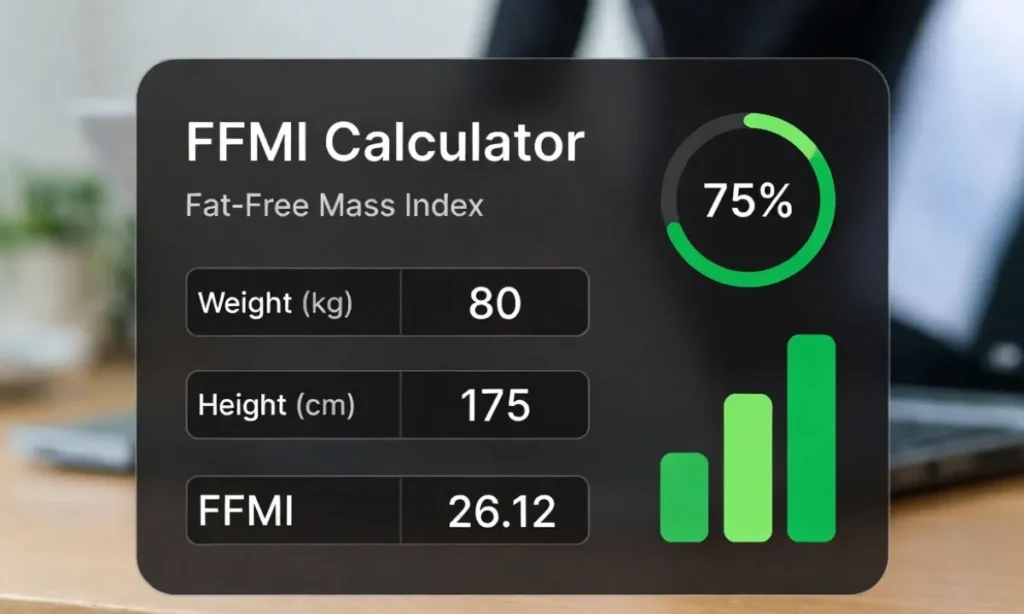
Meet Alex: Male, 5’11” (180 cm), 80 kg, 15% body fat.
- Body Fat: 80 × 0.15 = 12 kg
- Fat-Free Mass: 80 – 12 = 68 kg
- Height in m: 1.8 m
- FFMI: 68 / (1.8)² = 68 / 3.24 = 21.0 (Above average—great for natural progress!)
- Normalized FFMI: Same as height is average (1.8m).
Try this with your stats using our free FFMI calculator logic above.
Benefits of Tracking FFMI
- Accurate progress tracking: See muscle gains without fat skewing results.
- Health insights: Lower FFMI? Focus on strength training. High with low fat? You’re in peak condition.
- Steroid detection: FFMI >26 (men) or >22 (women) raises flags in competitive natural bodybuilding.
FAQs About Fat-Free Mass Index
What is a good FFMI score?
Men: 19–22 (healthy athletic range)
Women: 16–19
Athletes push higher naturally with diet and training.
How to improve FFMI without steroids?
Progressive overload weight training
High-protein diet (1.6–2.2g/kg bodyweight)
Calorie surplus for bulking, deficit for cutting (preserve muscle with cardio + weights)
What counts as fat-free mass?
Muscles, bones, organs, water, blood—everything except stored fat.
Is FFMI better than BMI for everyone?
For sedentary folks, BMI suffices. For anyone with muscle, FFMI is essential.
Ready to ditch BMI? Grab your height, weight, and body fat %, plug into the FFMI formula, and track your true gains. Whether you’re calculating normalized FFMI or aiming for that superior 23+, consistency is key.
Check our other Calculators